THE GET OUT (2026)
Summary:
After a nightclub owner with criminal connections decides it’s time to retire, a stolen cash drop sets off a tangled chain of robberies, betrayals, and unlikely partnerships in this crime comedy.
Review:
The Get Out belongs to a category of movies that once filled multiplexes with remarkable consistency but have become increasingly rare in recent years: the mid-budget crime caper aimed squarely at adult audiences. Aside from filmmakers like Steven Soderbergh, Hollywood doesn’t seem particularly interested in producing these kinds of character-driven thrillers anymore. While The Get Out doesn’t reinvent the genre, it offers a dependable premise, a talented cast, and enough stylish filmmaking to remain entertaining throughout its runtime. It never quite rises above being a pleasant diversion, but it’s still more engaging than several recent big-budget releases.
Russell Crowe stars as Manco Kapac, an Albanian immigrant who built an enviable life after relocating to Los Angeles years earlier. At first glance, Manco appears to embody the American dream. He owns one of the city’s trendiest nightclubs, enjoys considerable wealth, lives in an impressive home, and shares it with his stunning girlfriend Sunny (Teresa Palmer). Naturally, appearances prove deceptive. Behind the glamorous facade, the nightclub doubles as a money-laundering operation for a powerful Mexican cartel headed by Rodriguez (Daniel Zovatto). Years of balancing late-night business with dangerous criminal obligations have already taken their toll, and after combining the stress with an unfortunate Viagra overdose during an intimate evening with Sunny, Manco suffers a serious cardiac episode.
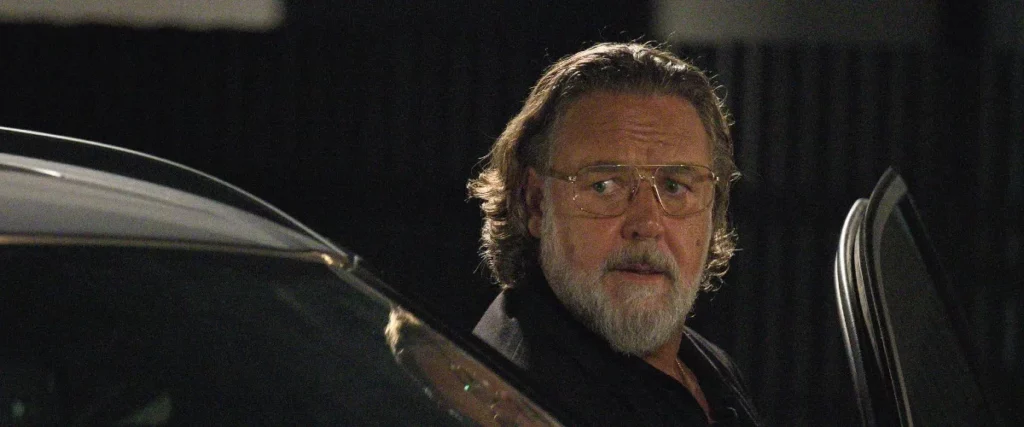
Faced with the reality that his health can no longer withstand his lifestyle, Manco begins considering an escape. A mysterious buyer named Joe (Luke Evans) expresses interest in purchasing the nightclub, giving Manco visions of leaving everything behind for a peaceful retirement on a distant tropical island. Of course, crime movies have repeatedly demonstrated that retirement plans rarely unfold as smoothly as expected. Anyone familiar with Carlito’s Way already knows that walking away from organized crime is usually much easier imagined than accomplished. Before Manco can put his plans into motion, disaster strikes when the $75,000 cash payment he’s transporting for Rodriguez is stolen during one of his routine money drops.
The thief turns out to be Jeff (Aaron Paul), a community college professor whose respectable career is supplemented by an unusual side business writing college admission essays that virtually guarantee wealthy students acceptance into prestigious universities. Unfortunately, one client fails to secure the promised scholarship, allowing the student’s father—a corrupt local police officer named Slosser (Josh McConville)—to blackmail Jeff into robbing Manco rather than facing criminal charges himself.
Jeff’s problems only multiply after he attempts to deposit part of the stolen money into his bank account. The transaction immediately catches the attention of teller Carrie (Nina Dobrev), who quickly realizes something suspicious is happening. Instead of contacting the authorities, however, Carrie reveals an entirely different motivation. A devoted fan of Point Break, she dreams of living out her own Johnny Utah fantasy and insists on becoming Jeff’s partner during his next robbery. Conveniently enough, Slosser soon demands another heist, ordering Jeff to target Manco once again during another scheduled cartel cash delivery.
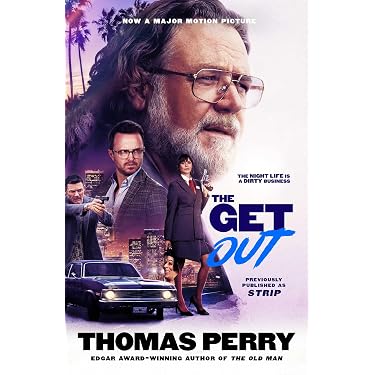
Although The Get Out is officially adapted from Thomas Perry’s 2010 novel Strip, director Derrick Borte and co-writer Daniel Forte appear to have significantly reworked the source material. The film’s biggest influence feels far less like Perry’s novel than the work of legendary crime novelist Elmore Leonard. Leonard built his reputation on intricate criminal plots populated by eccentric personalities, razor-sharp dialogue, and overlapping storylines that somehow always came together. Hollywood famously struggled for years to successfully translate his unique style onto the screen, producing uneven adaptations like The Big Bounce, Stick, and Cat Chaser before finally finding the right formula with films such as Get Shorty, Jackie Brown, and Out of Sight during the 1990s.
Unfortunately, The Get Out lands much closer to those earlier, less successful Leonard-inspired efforts than to the later classics. The screenplay introduces numerous interconnected storylines and colorful supporting characters, all of whom eventually collide as expected, but the individual threads never quite merge into a completely satisfying whole. Many isolated scenes work well on their own, yet the larger narrative lacks the cohesion needed to make the overall experience truly memorable.
The film also struggles to balance its conflicting tones. The first half leans heavily into quirky comedy and playful crime caper territory before gradually shifting toward darker violence and more serious dramatic stakes. That transition feels uneven rather than organic, creating a tonal inconsistency that occasionally works against the movie instead of enriching it. Compounding the issue is the surprising lack of sustained suspense. Despite Manco facing threats from dangerous criminals, dishonest police officers, and his own fragile heart, the film never fully convinces viewers that he’s genuinely in serious danger. Without that urgency, the climax ultimately arrives with less impact than it should, making the conclusion feel more mildly satisfying than genuinely exciting.
Even so, the film benefits enormously from Russell Crowe’s presence. Reuniting with director Derrick Borte after Unhinged, Crowe once again demonstrates his willingness to embrace colorful genre material without taking himself too seriously. This certainly won’t rank among the defining performances of his career, nor is it likely to appear in any future lifetime achievement montages, but he clearly enjoys every minute spent inhabiting Manco. He also adds yet another delightfully questionable accent to his ever-growing collection. Anyone who appreciated his gleefully over-the-top performances in The Pope’s Exorcist or Kraven the Hunter will likely find plenty to enjoy here as well.
The supporting cast contributes solid work across the board. Aaron Paul brings his trademark anxious energy to Jeff, while Nina Dobrev proves particularly entertaining as the eccentric Carrie. Their scenes together generate enough chemistry that it’s easy to imagine an entirely separate movie centered solely around their increasingly absurd criminal partnership. In many ways, they become the most consistently engaging part of the film.
Ultimately, The Get Out never fully succeeds either as a straight crime thriller or as a playful parody of one. Nevertheless, its easygoing personality and understated charm make it consistently watchable. It recalls an era when offbeat crime comedies comfortably occupied their own niche alongside films like The Hot Rock, Slither, The Pope of Greenwich Village, and The Whole Nine Yards. Viewers with a fondness for those quirky, character-driven capers may discover that The Get Out offers enough wit, personality, and old-fashioned entertainment to make the ride worthwhile, even if it never quite reaches the same heights.
Related Posts