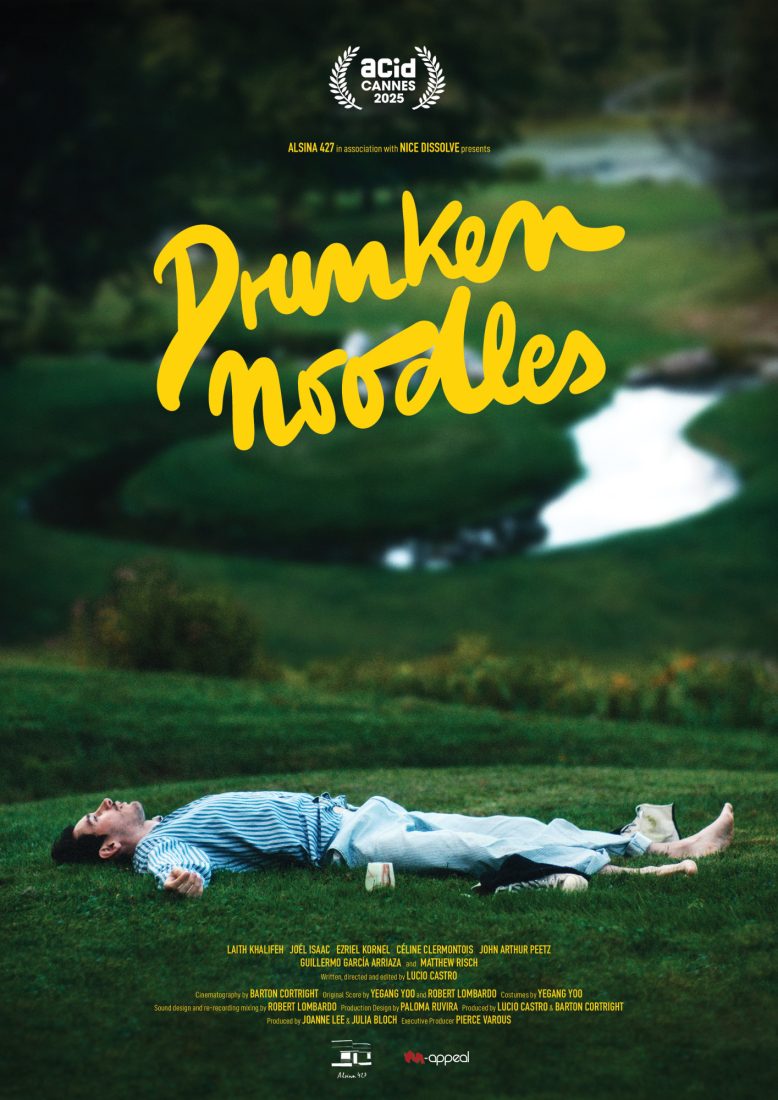
DRUNKEN NOODLES (2026)
Review Score:
Summary:
A young college student embarks on a deeply personal journey of identity, desire, and self-discovery after temporarily relocating to Brooklyn, where unexpected encounters reshape his understanding of love, art, and connection.
Review:
Cities can be every bit as romantic as the countryside, and sometimes the briefest encounter leaves a deeper impression than a long-term relationship. Those ideas form the emotional core of Drunken Noodles, a quietly mesmerizing queer drama that follows college student Adnan (Latif Khalifeh) during a transformative chapter of his life. While apartment-sitting for his uncle in Brooklyn, Adnan drifts through a series of intimate experiences that gradually blur the boundaries between romance, artistic inspiration, and personal awakening.
Rather than unfolding in a straightforward narrative, Adnan’s journey is presented through a collection of loosely connected, non-linear episodes that mirror the way memories and emotions naturally overlap. It isn’t always clear whether his evolving sense of self is shaped more by his magnetic connection with the enigmatic Yariel (Joel Isaac) or by the emotional strain surrounding his relationship with his boyfriend, Iggie (Matthew Risch). That ambiguity becomes one of the film’s greatest strengths, allowing viewers to experience Adnan’s internal world without forcing tidy conclusions.
One of the most rewarding aspects of Drunken Noodles is the way writer-director Lucio Castro continually stretches both time and space to accommodate the fluid movement of Adnan’s thoughts. Reality and memory intermingle with remarkable ease, creating an atmosphere where moments of reflection carry as much weight as the events themselves. Castro crafts a deeply personal meditation on queer identity, suggesting that romance, physical intimacy, and artistic expression all flourish when people give themselves the emotional freedom to embrace the connections between them.
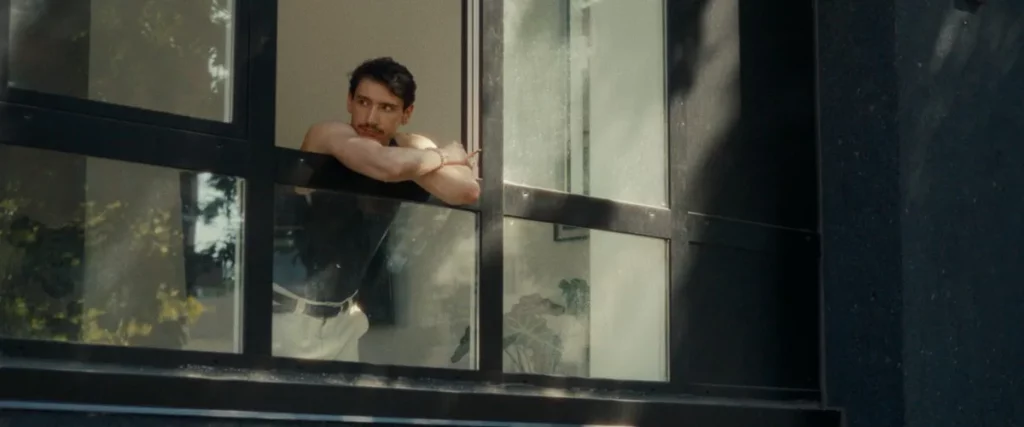
The audience joins Adnan midway through this emotional journey, first witnessing his chance meetings with Yariel, a food delivery worker with whom he shares an immediate and entirely believable chemistry. Their connection develops naturally, without dramatic declarations or manufactured conflict. During one of their conversations, Adnan introduces Yariel to the vibrant embroidered artwork of Long Island artist Sal Salandra, whose playful creations—many featuring unabashed nudity—spark memories of Adnan’s own introduction to the artist’s work.
Salandra’s presence carries significance beyond the story itself. In reality, his textile art served as the original inspiration for Castro’s project, which initially began as a documentary centered on the artist. Although that concept eventually evolved into a fictional narrative, Salandra remains woven into the film through both his artwork and a fictionalized version of himself portrayed by Ezriel Kornel. Rather than producing a conventional biographical portrait, Castro transforms that inspiration into what he describes as a “liminal space of desire,” allowing imagination and reality to comfortably coexist.
What ultimately makes Adnan’s story so compelling isn’t simply the way he discovers common ground between sexuality and artistic expression. Instead, Castro demonstrates an exceptional ability to create visual and emotional harmony between seemingly opposite environments. Peaceful natural landscapes filled with trees, winding dirt roads, and quiet streams exist alongside vibrant city settings where unexpected connections emerge in apartments, galleries, playgrounds, and bustling streets. The contrast never feels forced. Instead, both worlds become equally inviting spaces where intimacy can naturally unfold.
The relationship between Adnan and Yariel beautifully illustrates this balance. Castro portrays their growing bond with equal measures of tenderness and physical attraction, refusing to treat it as merely an escape from or reaction to Adnan’s more complicated relationship with Iggie. Both relationships exist as meaningful parts of Adnan’s emotional landscape. Balancing grounded sensuality with more abstract emotional exploration, Castro develops a filmmaking style that gradually feels less like traditional storytelling and more like entering a vivid lucid dream.
The film’s understated yet evocative soundtrack further reinforces that dreamlike quality. Ambient sounds frequently replace conventional musical cues, with chirping crickets, distant traffic, and lingering environmental noises creating a soothing backdrop that follows Adnan from one quiet encounter to the next. Rather than explaining his emotions through dialogue, Castro encourages viewers to experience them intuitively. The result is an atmosphere where feelings emerge organically through mood, rhythm, and visual association.
Viewed through that lens, Drunken Noodles becomes less concerned with plot than with the transformative moments that occur when intellectual curiosity, artistic appreciation, and human desire intersect. Castro suggests that genuine self-discovery doesn’t necessarily arrive through dramatic revelations but instead grows from remaining open to experiences without judging or compartmentalizing them.
Adnan isn’t attempting to transcend the physical world or escape emotional burdens. Instead, he embraces an occasionally mysterious process of personal exploration that gradually deepens his connection with the people, places, and artistic inspirations surrounding him. While the film’s free-flowing structure won’t resonate equally with every viewer, even its most surreal passages—including a carefully staged tableaux vivant-inspired orgy and a late-night meeting with a flute-playing faun sporting unmistakably kinky overtones—carry surprising emotional clarity beneath their whimsical surfaces.
Rather than elevating either sexuality or artistic expression above the other, Castro celebrates both as equally valid forms of self-discovery. Adnan’s evolving desires aren’t presented as obstacles requiring resolution or as stepping stones toward some grand emotional breakthrough. Instead, they simply become expressions of an identity still unfolding, revealing personal truths without insisting upon definitive answers.
In that respect, Drunken Noodles both embraces and quietly subverts the conventions of romantic drama. Romance certainly plays an important role, but the film is ultimately less interested in lasting relationships than in the beauty of temporary connections and emotional possibility. Adnan finds fulfillment not through reaching a destination, but through longing itself and through the fleeting encounters that momentarily bridge people, places, and ideas. Castro looks beyond surface-level differences to celebrate the quiet, everyday magic of human connection—even when its deepest meanings remain just out of reach.
Related Posts