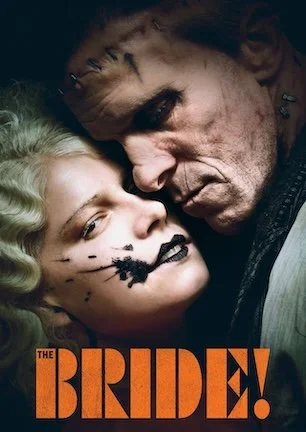
THE BRIDE (2026)
Studio: Warner Bros. Pictures
Director: Maggie Gyllenhaal
Writer: Maggie Gyllenhaal
Producer: Maggie Gyllenhaal, Emma Tillinger Koskoff, Talia Kleinhendler, Osnat Handelsman Keren
Stars: Jessie Buckley, Christian Bale, Peter Sarsgaard, John Magaro, Jeannie Berlin, Annette Bening, Jake Gyllenhaal, Penelope Cruz
Review Score:
Summary:
A strange romance between Frankenstein’s Monster and a woman brought back from the dead ignites a sweeping cultural uprising in 1930s Chicago.
Review:
Context has always played an important role in both writing and reading movie reviews. Experienced filmgoers know that festival buzz should always be approached with caution. In those environments, the excitement of premieres often encourages critics and attendees to shower films with glowing praise, sometimes because they genuinely love what they’ve seen, and sometimes because being among the first to champion a future sensation carries its own appeal. The same skepticism applies to lavish Hollywood premieres, where influencers and media personalities are frequently treated to luxury hospitality and exclusive gifts that can unintentionally color first impressions.
Timing continues to matter even after a film reaches regular audiences. Maggie Gyllenhaal’s The Bride—or The Bride! for those who embrace the emphatic punctuation—serves as an excellent example. Anyone paying attention only to the critical conversation surrounding its theatrical debut in March 2026 could easily have concluded that the film was an instant masterpiece. One reviewer declared it “your new favorite movie,” insisting there was virtually nothing negative to report while awarding it a remarkable 90/100 score. Another praised it as “an explosive representation of social disruption.” Numerous critics quickly shifted the discussion toward awards potential, celebrating the performances while applauding Gyllenhaal’s eccentric vision for breathing new life into familiar mythology through bold, unconventional filmmaking.
Only a couple of months later, however, The Bride arrived on Blu-ray after already becoming available through digital rental platforms. By then, horror communities across social media had already moved on to newer releases, while mainstream entertainment outlets had found fresher titles to champion. In less than eight weeks, what had initially been positioned as an essential cinematic event quietly slipped from public conversation, becoming another heavily promoted release that disappeared from the spotlight almost as quickly as it arrived.
That naturally raises an interesting question. Did those early reviews unintentionally inflate the film’s cultural importance, or were casual audiences simply less receptive to the larger themes Gyllenhaal was attempting to explore through her highly stylized reinterpretation of Frankenstein’s tragic mythology? As is often the case, the truth probably lies somewhere between those extremes. Individual reactions ultimately depend on how willing viewers are to engage with both the film’s unconventional storytelling and its aggressive thematic ambitions.
The Bride itself is built on contrasts in more ways than one. Gyllenhaal constantly swings between two very different storytelling approaches. At times, the movie presents its ideas with almost overwhelming directness, shining enormous spotlights on its social commentary. At other moments, those same intentions become buried beneath cryptic symbolism, overwritten conversations, and emotionally heightened scenes that often leave viewers uncertain about exactly what point is being made.
The film also functions as something of a legacy continuation, similar to how David Gordon Green’s Halloween (2018) essentially ignored decades of sequels in favor of picking up directly after John Carpenter’s original classic. Although Gyllenhaal frames The Bride as a continuation of Mary Shelley’s novel, it’s equally easy to imagine it existing within the universe established by the 1931 Frankenstein starring Boris Karloff, while disregarding the sequels that followed.
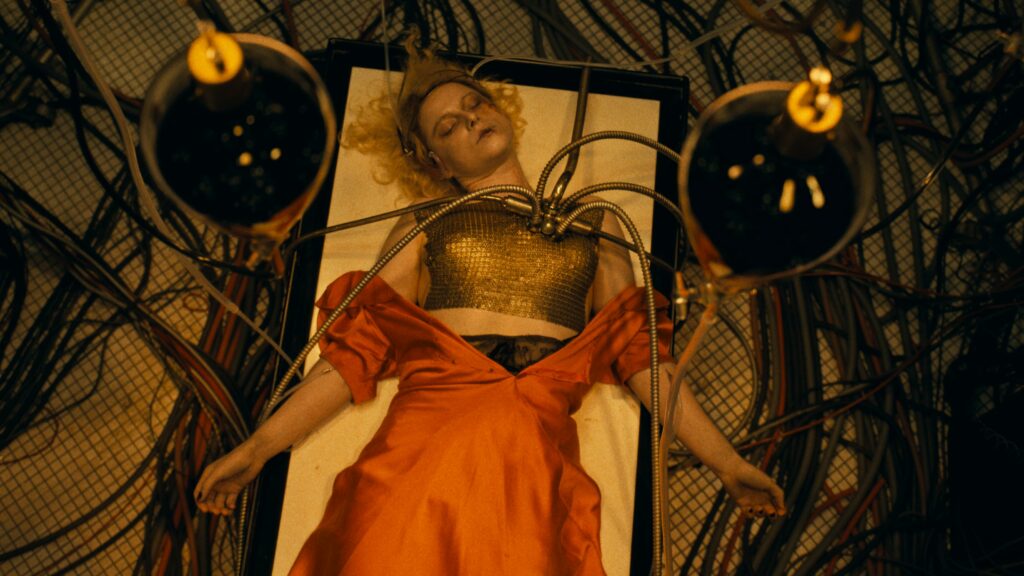
Following the events of those earlier stories, Frankenstein’s Monster (Christian Bale), referred to here simply as “Frank,” has spent generations wandering the world in search of relief from his endless loneliness. His journey eventually brings him to 1936 Chicago, where he finds Dr. Cornelia Euphronious (Annette Bening), a scientist whose expertise lies in rejuvenation and resurrection. Frank persuades Cornelia to create him a companion using the body of Ida (Jessie Buckley), a spirited socialite whose sharp wit recalls Mae West while her glamorous style evokes Clara Bow. Ida met a violent end after publicly humiliating a notorious crime boss, but even after returning from the dead as a monstrous creation herself, she refuses to surrender her fierce independence. Unsurprisingly, Frank becomes completely captivated by someone who is every bit as fearless as she is unpredictable.
What follows isn’t simply a romantic journey but an emotional rediscovery, particularly for Ida. As she struggles to reconcile the woman she once was with the extraordinary creature she has become, her relationship with Frank forces her to reconsider her identity and future. Their travels also trigger violence wherever they go, as frightened citizens, angry mobs, and nervous police officers react irrationally to the sight of the unusual couple. Their actions attract the attention of a determined detective (Peter Sarsgaard) alongside his perceptive partner Myrna Malloy (Penelope Cruz), whose dynamic delivers perhaps the most unmistakable homage imaginable to The Thin Man. Meanwhile, the mob boss responsible for Ida’s original death seeks to eliminate her once again after she inspires women to rise against abusive, misogynistic men like himself.
If there’s one thing The Bride never attempts to be, it’s subtle. The film leaves little room for ambiguity during sequences like the one featuring a police officer appropriately named “Goodman,” who drags the Bride from a vehicle before disguising sexual harassment as a routine search, using the opportunity to make degrading comments while violating her personal space. The symbolism is equally transparent during an earlier dinner party scene, where Ida is pressured into swallowing an oyster against her wishes, forced to politely say “please” before the unwanted delicacy is shoved into her mouth.
While those moments communicate their intentions quite clearly, other aspects of the film are considerably harder to interpret. Ida—and later the Bride—frequently delivers bizarre streams of dialogue using an intentionally unusual accent and a screenplay filled with poetic wordplay. Her speeches overflow with phrases like, “a paucity, a poverty, crumbs from a stifled mind. And they are gobbled, gulped, scoffed, wolfed.” Elsewhere, introductions become elaborate chains of rhyming expressions: “Slow down, mate. Shipmate. Helpmate. Stalemate. Amalgamate. Imitate. Decimate. Transubstantiate. Sublimate. Consummate. Checkmate,” interrupted midway only by an unexpected burp.
Part of this surreal dialogue is explained through one of the film’s strangest narrative choices. Ida gradually becomes inhabited by the spirit of Mary Shelley herself. During a black-and-white prologue that openly breaks the fourth wall, Shelley explains that something within the afterlife has fractured, compelling her to inhabit Ida’s consciousness in order to finally tell a story she can no longer contain. Her memorable declaration, “Here comes the motherf*cking Bride,” announces what is meant to become an unstoppable force of rebellion, even if the film never entirely clarifies where that revolution is ultimately headed.
Despite all of its eccentricities, The Bride leaves little doubt about its central message. The film repeatedly challenges patriarchal systems and the societal expectations placed upon women. Frank may initially view the Bride as someone created specifically for him, but every attempt by men to define, restrain, or possess her ultimately strengthens the rebellion she inspires. The women drawn to her example—including the intelligent and frequently overlooked Myrna, whose insights are constantly ignored in favor of her male partner’s opinions—represent a growing rejection of deeply rooted gender inequality. On the other hand, sequences such as the elaborate Broadway-inspired dance routine, where Frank and the Bride respond to an insult by leading an impromptu musical number, remain difficult to interpret beyond their obvious commitment to spectacle.
Ultimately, The Bride feels like an experimental production made by accomplished Hollywood veterans deliberately abandoning conventional storytelling in favor of creative exploration. Beneath its confident visual style lies the occasional sensation of filmmakers improvising ambitious ideas without fully knowing how they’ll fit together. Fortunately, the considerable resources behind the production ensure that every frame benefits from lavish design, striking cinematography, and an impressive cast fully committed to Gyllenhaal’s vision. Everyone involved clearly embraces the opportunity to push artistic boundaries without compromise. Whether that experiment ultimately succeeds, however, remains open to debate, leaving audiences to decide for themselves whether The Bride evolves into a genuinely powerful cultural statement or simply an intriguing curiosity wrapped in exceptional craftsmanship.
Review Score: 55
Related Posts