CAMP (2026)
Summary:
Haunted by overwhelming guilt after a devastating tragedy, a young woman finds herself drawn into a secretive circle of teenage witches at a remote summer camp, where grief, magic, and self-destruction become impossible to separate.
Review:
Stories about grief usually follow a familiar emotional trajectory. Characters spiral into despair, make terrible decisions, and eventually emerge stronger, cleaner, and emotionally renewed. By the closing scenes, they’ve accepted their loss, rebuilt their lives, and found the strength to move forward. Avalon Fast’s CAMP deliberately rejects that comforting formula. Instead, the Canadian writer-director presents an alternative vision of grief and guilt—one where healing isn’t guaranteed, redemption isn’t required, and life may continue in complete emotional chaos. Maybe things eventually improve. Maybe they don’t. Either way, the film argues that our attempts to control those outcomes often matter far less than we’d like to believe, a surprisingly liberating perspective despite its unsettling implications.
That rejection of traditional morality extends throughout the entire film. CAMP dismisses familiar ideas of sin, repentance, and spiritual redemption in favor of something morally ambiguous that pairs naturally with its supernatural themes. Its witches aren’t misunderstood heroes, but neither are they straightforward villains. They willingly inflict pain when necessary, embracing forms of magic that demand genuine sacrifice. Yet Fast surrounds these acts with such warmth, intimacy, and emotional sincerity that the film frequently feels less like horror than an oddly comforting coming-of-age drama. Rather than urging its protagonist to overcome darkness, CAMP invites her to step into it and discover what—or perhaps who—awaits her there.
Emily (Zola Grimmer), the film’s central character, arrives carrying more emotional baggage than someone her age should ever have to bear. Barely out of high school, she already blames herself for two deaths, including the overdose of her closest friend during an emotionally devastating opening sequence that unfolds inside Emily’s parked car. Although neither tragedy was intentional, the crushing weight of responsibility leaves her emotionally hollow. Hoping distance and routine might offer some healing, Emily’s father (Michael Tan) encourages her to spend the summer working as a counselor at a remote camp in northern British Columbia for children he gently describes as “damaged.” He hopes the new environment will help his daughter reconnect with herself. In many ways, it does—but certainly not in the way either of them expects.
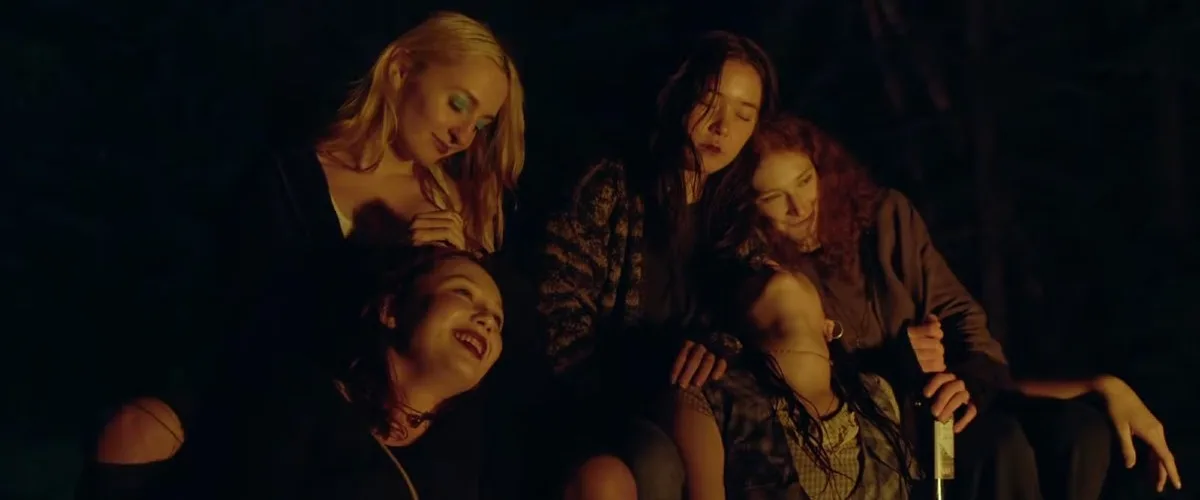
Shortly after arriving at the unnamed campsite—identified simply as “CAMP” on every sign and bus—Emily is welcomed into a close-knit group of rebellious young women who immediately take her under their wing. Clara (Alice Wordsworth), Rosie (Cherry Moore), Nev (Lea Rose Sebastianis), and Hope (Ella Reece) spend their days maintaining the appearance of an ordinary Christian summer camp for troubled teenagers. Once darkness falls, however, bonfire parties give way to occult rituals as the girls secretly practice witchcraft deep within the surrounding wilderness. Their supernatural abilities come at a cost. Every spell demands a sacrifice, and the greater the offering, the more powerful the magic becomes.
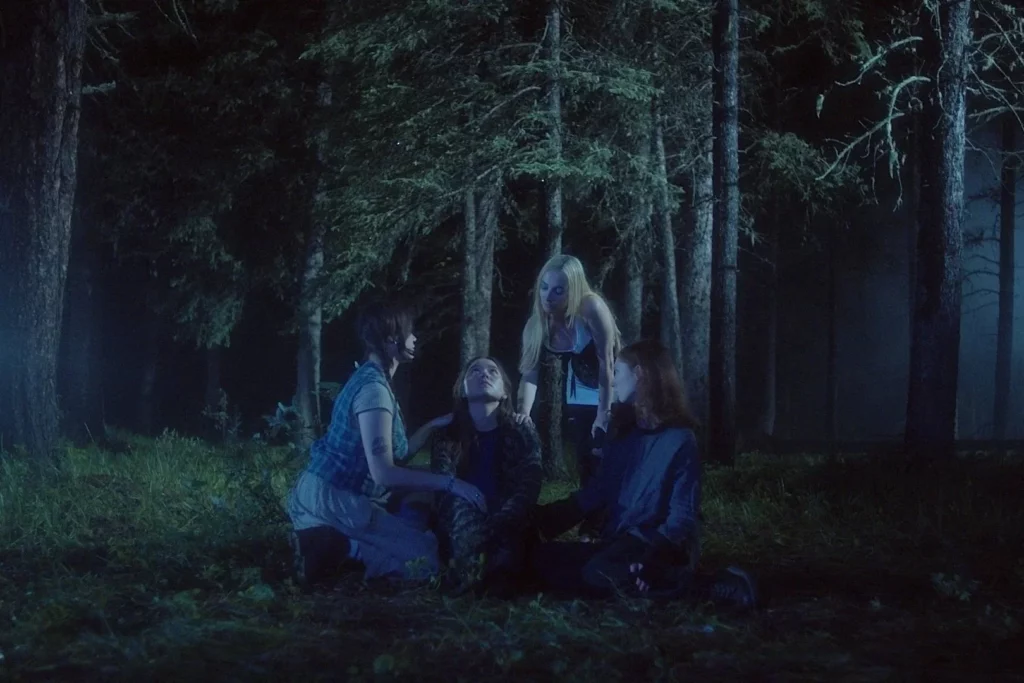
The film’s official synopsis references “cursed cycles,” and that description captures the atmosphere remarkably well. Throughout CAMP, an invisible force lingers over every scene, simultaneously comforting and deeply unsettling. Much of that dreamlike quality comes from cinematographer Eily Sprungman’s gorgeous visual approach. Soft-focus photography, often appearing as though a thin layer of petroleum jelly has been smeared across the lens, surrounds the characters with glowing halos that blur the boundary between reality and fantasy. Complementing those images is Max Robin’s textured score, whose waves of distorted ambient sound further immerse viewers in the film’s strange emotional landscape. While Avalon Fast is still developing her cinematic voice, she already demonstrates considerable confidence behind the camera, blending handcrafted multimedia flourishes with intimate, imaginative compositions that consistently reinforce the movie’s enchanted atmosphere.
The ritual sequences and dreamlike visions stand among the film’s most memorable moments. Beneath crimson moons and inside mist-covered forest clearings, Emily gradually loses herself within ceremonies that seem suspended somewhere between nightmares and spiritual awakenings. Surrounded by whispered voices encouraging her to “fall from grace,” she asks what lies beneath that fall. The answer—”All of this”—perfectly captures the film’s philosophy, embracing uncertainty rather than resisting it.
Within these surreal moments, the intentionally stylized performances feel completely appropriate. Outside them, however, the film demands a degree of patience. CAMP establishes its hypnotic rhythm gradually, filling many early conversations with long silences and understated exchanges that may initially challenge viewers unfamiliar with similarly experimental genre filmmaking. Fans of directors like Jennifer Reeder or Jane Schoenbrun will likely adapt to the film’s unusual cadence much more quickly. Even for more skeptical audiences, though, the remarkably natural chemistry shared by the cast steadily smooths the transition into Fast’s unique cinematic wavelength. Many of the performers are close friends away from the camera, and that genuine familiarity quietly enriches every interaction.
Although “ethereal” remains the single best word to describe CAMP, traces of the raw, untamed spirit that defined Fast’s earlier feature Honeycomb continue simmering beneath its shimmering exterior. Across both films, Fast has shown a clear fascination with groups of adolescent girls and young women, particularly the strange mixture of tenderness, loyalty, violence, and emotional intensity that defines those relationships. CAMP expands upon those recurring interests by exploring how communities can simultaneously nurture and consume the individuals within them. It captures the intoxicating exhilaration—and undeniable danger—of surrendering your identity to a collective. Like the rituals its characters perform, the film ultimately asks its audience to embrace uncertainty, trust the unknown, and take a leap of faith.
Related Posts