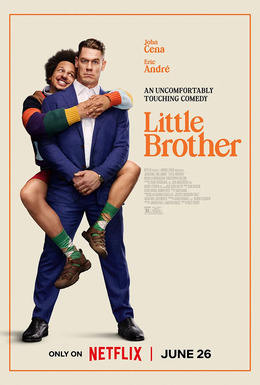
LITTLE BROTHER (2026)
Summary:
A wealthy real estate mogul’s carefully controlled life is thrown into chaos when the eccentric man he once mentored unexpectedly reappears, forcing him to confront family wounds, social inequality, and the true meaning of success.
Review:
John Cena has headlined plenty of comedies, but Little Brother ranks among his strongest starring vehicles to date. Director Matt Spicer, working from a screenplay by Jarrad Paul and Andrew Mogel, delivers an unapologetically raunchy, slapstick-heavy comedy that balances crude humor with surprisingly heartfelt emotion. It never quite reaches greatness—the film leaves several intriguing ideas underdeveloped and wraps up just as its story seems ready to become even richer—but it understands exactly what kind of comedy it wants to be. More importantly, it fully commits to that identity, resulting in a clever, sincere, and consistently funny crowd-pleaser that’s likely to reward repeat viewings.
Cena stars as Rudd Landy, a moderately famous real estate entrepreneur who transformed a modest upbringing into an impressive property empire. He’s preparing to compete on NYC Hustlers, a ruthless reality television competition centered on high-end real estate deals. While Rudd appears to have achieved everything society considers success, his relentless pursuit of wealth and public recognition has steadily eroded his personal life. His wife, Deirdre (Michelle Monaghan), their two teenage sons (Bryce Ghesier and Pilot Bunch), and even his endlessly patient assistant Mia (Sherry Cola), who manages both his emails and carefully crafted public image, all suffer from his constant obsession with business. At its core, Rudd represents the familiar cinematic archetype of the wealthy workaholic who must rediscover life’s more meaningful priorities. It’s hardly an original premise, but in capable hands, it’s one audiences rarely tire of revisiting.
Driving much of Rudd’s ambition is a deeply personal source of insecurity. His older brother Josh (Chris Meloni) has always overshadowed him, becoming an even bigger name in the real estate world while consistently making Rudd feel inadequate. Decades later, that sibling rivalry remains painfully intact. During a fundraising gala organized by Deirdre, Josh casually informs everyone that he’s putting his lavish sixteen-million-dollar mansion up for sale—but won’t be listing it through his own brother. Moments later, he effortlessly steals the spotlight again by donating ten times more money to Deirdre’s charity than Rudd had contributed, reinforcing the same lifelong pattern of one-upmanship.
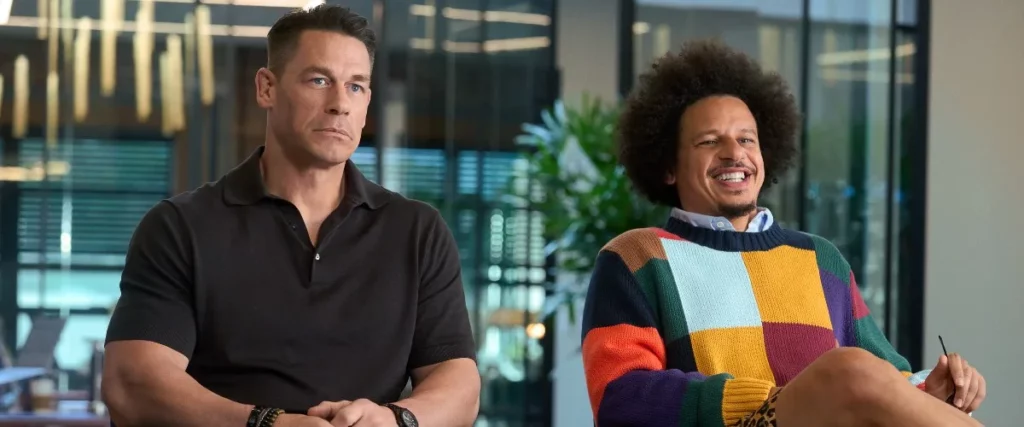
The story truly begins, however, with the arrival of Marcus Pinchel (Eric André), an orphan who briefly participated in the Big Brothers and Sisters program with Rudd roughly thirty years earlier. Marcus escapes from a mental health facility where his roommate sincerely believes he’s married to a large rock decorated with googly eyes. To his credit, the rock receives exceptionally attentive care. The opening act frequently cuts between Rudd’s luxurious lifestyle and Marcus’s daily struggle to survive while homeless. Despite sleeping in his car—always wearing an eye mask because, as he points out, he still has standards—and washing himself beneath golf course sprinklers while politely encouraging confused golfers to “play through,” Marcus maintains an infectious optimism that never feels forced.
Eventually, Marcus inserts himself into the Landy household by introducing himself as Rudd’s brother, stretching the definition of family well beyond its conventional meaning, as Rudd repeatedly reminds everyone. Deirdre immediately embraces Marcus, fitting perfectly with her well-intentioned but somewhat performative desire to help others. She devotes herself to charitable causes, fosters disabled shelter animals—including a dog whose missing back legs have been replaced with wheels—and pours endless energy into her nonprofit organization. The film also takes sharp satirical aim at charitable organizations themselves, suggesting they often serve as inadequate substitutes for meaningful public support systems. Deirdre’s foundation, Mattress Miracles, proudly operates under the slogan “Homeless, not Sleepless,” celebrating a major triumph when Paris Hilton appears via Skype to announce a donation of one hundred thousand mattresses.
This proudly R-rated comedy thrives on outrageous humor, and both Cena and André prove exceptionally comfortable operating in that space. The supporting cast—including Monaghan, Meloni, and everyone else involved—matches their energy remarkably well. The screenplay delights in absurdly elaborate sexual euphemisms, with Marcus enthusiastically recommending someone “go Joey Chestnut on a cinnamon ring” before proposing the creation of “a human centipede of commonality.” Bodily-function jokes arrive in abundance, highlighted by one unforgettable sequence in which Marcus publicly relieves himself in a way unlike anything I’ve encountered in decades of watching movies. The film even includes an unexpectedly explicit—albeit strategically obscured—public sex scene, punctuated by a priceless close-up of Cena’s stunned facial expression that practically begs to become an internet meme.
Beneath all the outrageous comedy, though, Little Brother has considerably more on its mind than its surface suggests. One recurring theme explores the lasting emotional scars inflicted by bullies and toxic family dynamics. The unhealthy relationship between Rudd and Josh has already begun repeating itself through Rudd’s own sons, illustrating how these cycles perpetuate themselves across generations. Another major theme embraces a broadly progressive vision rooted in compassion and collective responsibility, placing the film in conversation with socially conscious comedies stretching from Preston Sturges and Hal Ashby to contemporary storytellers like James Gunn, whose collaborations with Cena in The Suicide Squad and Peacemaker similarly argue that empathy forms the foundation of any functioning society.
The movie also repeatedly addresses America’s deeply entrenched social and economic inequalities. Although Rudd and Josh didn’t grow up wealthy, Josh has reinvented himself as the embodiment of obnoxious new-money excess, while Rudd continues carrying decades of insecurity born from impossible standards of success. Marcus, meanwhile, represents the opposite end of society’s spectrum. Poor, homeless, and Black, he faces multiple systemic disadvantages simultaneously. His circumstances are so dire that institutionalization and hospitalization become his only reliable sources of shelter. Yet remarkably, even after being struck by a garbage truck—a bizarre accident that ultimately reunites him with the Landys after naming Rudd as his only emergency contact—Marcus refuses to surrender his optimism.
The screenplay also uses the Big Brothers and Sisters program as an unmistakable metaphor for the broader network of public services designed to reduce inequality. Rather than treating the mentorship program as merely a plot device, the film presents it as symbolic of social safety nets that have gradually been weakened, defunded, or neglected. Meanwhile, the movie’s various influencers—whether reality television producers, social media personalities, or Josh himself—represent a culture increasingly driven by inherited privilege, corporate opportunism, image management, and economic systems that reward connections over compassion while transforming every aspect of life into marketable content.
To be fair, Little Brother never fully capitalizes on all of these fascinating ideas. Several promising storylines receive only partial attention before being abandoned. The weakest example involves Mia accidentally catfishing Marcus after responding to one of his emails while pretending to be Rudd, violating company policy in the process and unintentionally convincing Marcus that Rudd genuinely wanted to reconnect. Although this subplot creates the circumstances bringing Marcus back into Rudd’s life, it ultimately fizzles without delivering much emotional payoff. Likewise, many of the film’s richer themes are introduced clearly enough to be noticed but never explored deeply enough to leave a lasting impact. Even so, the movie deserves recognition for attempting to weave meaningful observations about inequality and cruelty into what could easily have remained a purely silly comedy.
Cinema has produced countless slapstick comedies grounded in fundamentally compassionate worldviews. At their best, these films use exaggerated physical humor and outrageous situations to encourage audiences to empathize with people they might otherwise dismiss. Many of the finest examples feature Cena’s frequent collaborator Will Ferrell portraying lovable man-children whose emotional immaturity creates endless chaos despite their fundamentally decent hearts.
Both Rudd and Marcus fit comfortably within that tradition, despite occupying opposite ends of the economic ladder. Each is, in his own way, a little brother longing for acceptance from someone who consistently withholds affection. Their respective older brothers—whether literal or symbolic—remain largely indifferent to the pain they cause, sometimes ignoring it altogether and sometimes actively making matters worse. Yet neither Rudd nor Marcus allows disappointment to extinguish hope. One line spoken to Rudd ultimately resonates far beyond him, applying equally to Marcus and perhaps to humanity as a whole: “You’ve been wronged by so many people, but you still have so much love to give.”
Related Posts