ROMERÍA (2026)
Summary:
An 18-year-old woman travels to Vigo in search of her biological origins, only to uncover a fragmented family history shaped by silence, contradiction, and emotional distance, forcing her to question memory, identity, and belonging.
Review:
I have to admit I came to Carla Simón’s Romería without prior familiarity with her earlier work, including Summer 1993, which, like this film, draws from autobiographical material shaped into fiction. While Summer 1993 centers on childhood experience, Romería shifts its focus to adolescence—a stage where learning is often overshadowed by yearning. Simón’s second feature, Alcarràs, moved away from strictly personal storytelling to portray a Catalonian farming family, and in doing so demonstrated her ability to work with non-professional actors and fully immerse herself in regional dialect and culture. Romería, however, returns to the terrain of intimate personal history, exploring identity through the perspective of Marina, an 18-year-old played by Llúcia Garcia, whose journey is defined by a search for origins she has never fully understood.
Marina has been raised by her aunt and uncle for reasons that remain only partially explained to her, and now she has arrived in the Spanish port city of Vigo seeking clarity about her biological parents. Her uncle Lois, who lives nearby on a large houseboat with his own family, becomes her first point of contact. Warm and seemingly open-hearted, he shares fragments of information about her past, though his version of events is soon contradicted by other relatives on land. The result is a widening spiral of uncertainty, where every answer seems to generate a new inconsistency. Her Aunt Olalla, who lovingly sews Marina a striking red dress, simultaneously appears to encourage emotional distance between Marina and the rest of the family, as though something unspoken and unresolved continues to shape their relationships. Another relative, Iago—more progressive in temperament and less guarded—offers her a slightly more sympathetic perspective, though even his account fails to provide a coherent full picture.
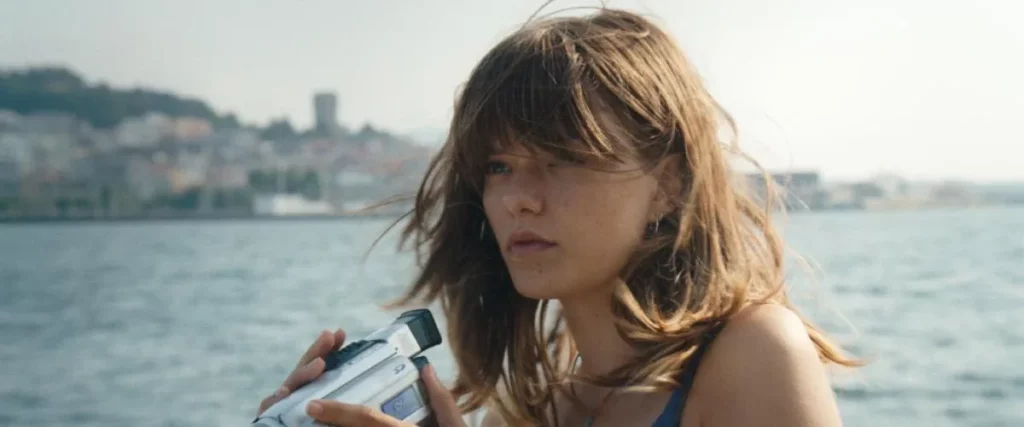
Eventually, Marina learns that her father did not die when she was an infant, as she had always believed, but when she was around five years old. This revelation unsettles her deeply. If that is true, why does she have no memory of him? Why was his presence seemingly erased from her life so completely? These questions begin to define her emotional state as much as the search itself.
As Marina continues to probe her family’s contradictions, she spends increasing amounts of time with Nuno, one of Lois’s sons. Her behavior begins to shift as well. She resists the quiet attempts to contain her curiosity, including a moment where her grandfather tries to press an envelope of money into her hands—an offer she rejects with visible discomfort. In another act of quiet defiance, she throws a bag of leaves into a swimming pool, a small but symbolic gesture that reflects her growing resistance to the family’s attempts to manage or redirect her inquiries.
At this point, Romería gradually begins to shift into a more elusive, almost magical-realist register. Marina follows a stray cat to an unfamiliar doorway, which leads her toward the pier. There she discovers a rowboat, boards it without hesitation, and rows out into open water. By morning, she has reached a large ship anchored offshore. She climbs aboard via a rope ladder and, within this surreal transitional space between land and sea, begins to uncover deeper truths about her identity and origins—truths that feel as much emotional and symbolic as they do factual.
Simón directs these transitions with notable confidence, allowing the boundaries between reality, imagination, and hallucination to remain deliberately indistinct. Each carries equal emotional weight, as though all versions of Marina’s experience are necessary parts of the same internal truth. In this sense, the film resists strict narrative certainty in favor of psychological and emotional coherence, where understanding emerges less from facts than from accumulation and feeling.
By the conclusion of this measured, sometimes languid, sometimes quietly devastating film, Marina’s search reveals both emotional and practical consequences. Establishing definitive proof of her lineage allows her to pursue university funding opportunities she had previously been unable to access. In retrospect, her earlier rejection of her grandfather’s envelope of money takes on new meaning: it was not merely pride or rebellion, but an instinctive refusal to accept a transactional substitution for truth. The title Romería, meaning a pilgrimage—often with religious or spiritual connotations—becomes increasingly resonant. Simón frames Marina’s journey as something approaching a secular rite of passage, where the pursuit of identity itself becomes an act of devotion. For viewers willing to follow its quiet, shifting currents, Romería offers a deeply rewarding and reflective cinematic pilgrimage.
Related Posts