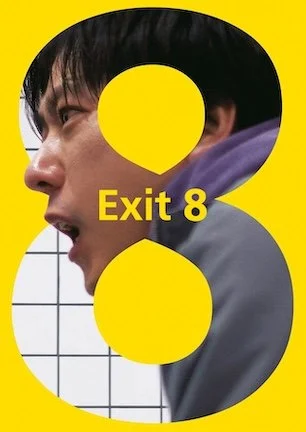
EXIT 8 (2025 – Japanese)
Studio: Toho/Neon
Director: Genki Kawamura
Writer: Kentaro Hirase, Genki Kawamura
Producer: Yuto Sakata, Kenji Yamada, Akito Yamamoto, Taichi Ito
Stars: Kazunari Ninomiya, Yamato Kochi, Naru Asanuma, Kotone Hanase, Hirota Otsuka, Tara Nakashima, Reo Soda, Mikio Ueda, Hikakin, Nana Komatsu
Review Score:
Summary:
Trapped inside an eerie, seemingly endless subway passage, a man must navigate a series of supernatural anomalies while confronting his own personal regrets in order to find the elusive Exit 8.
Review:
Whenever I review a movie adapted from existing material, I usually mention whether I’m familiar with the original work if I think that information might matter to fans comparing the adaptation. Not long ago, while covering another book-to-film adaptation, I found myself once again admitting that I hadn’t read the novel it was based on. It struck me that I had been making that disclaimer quite frequently. Since I’ve also been trying to read more in general, I decided I should make a stronger effort to experience source material beforehand whenever possible, allowing me to approach adaptations with a better understanding of what changed and what stayed the same.
That opportunity arrived much sooner than expected with Exit 8. Unlike a lengthy novel requiring days of reading, The Exit 8 is an independent video game I’d heard mentioned several times. Before watching the film, I figured playing the game first would provide useful context for the review. The decision seemed even easier because it was included with PlayStation Plus, featured only four trophies, and reportedly took less than an hour to complete. According to How Long to Beat, most players finished it in under sixty minutes, while a few claimed to complete repeat runs in only six or seven minutes. Considering the minimal time commitment, giving the game a chance felt like an obvious choice.
I knew very little going in beyond its central premise. You control someone trapped inside a looping subway corridor, searching for the mysterious Exit 8 while trying to escape an endlessly repeating underground passage.
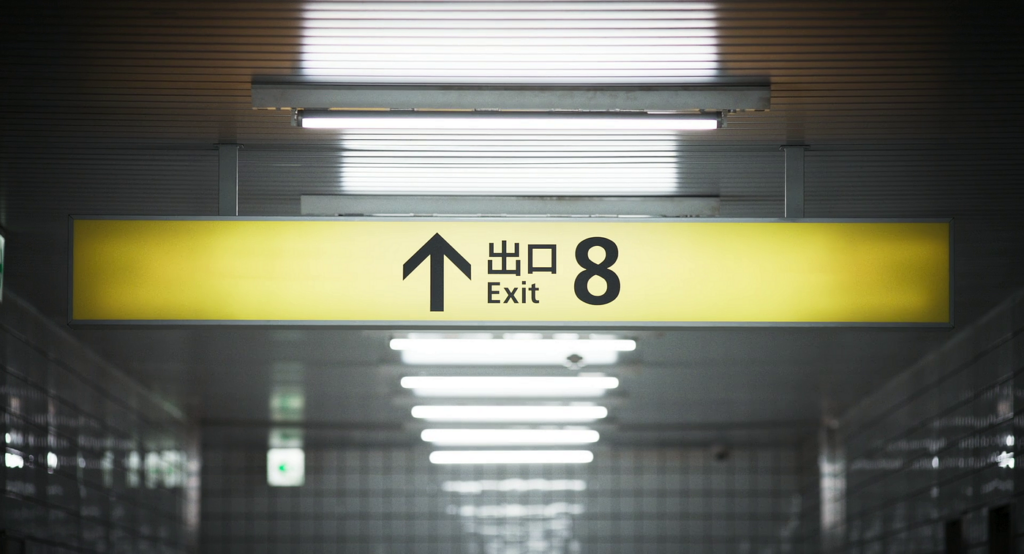
The setup is deceptively simple.
You begin inside a long hallway. Along the left wall hang six posters accompanied by a sign. The opposite wall contains three doors, two ventilation grates, and an emergency control panel. Fluorescent lights stretch across the ceiling, yellow safety lines run along the floor, and several dome-shaped security cameras overlook the corridor. The only other visible person is a silent businessman carrying a briefcase as he calmly walks toward you. If you turn around and follow him instead, he merely stops and quietly stares at his cellphone.
Initially, the game offers absolutely no instructions. There is no tutorial, no helpful menu explanation, and no guidance whatsoever. Pressing any button simply makes your character walk slightly faster, which quickly becomes appreciated because the normal pace feels painfully sluggish, as though you’re controlling someone a century old relying on a walking cane.
Eventually, you reach the end of the hallway, turn left into a smaller passage, then right, then left again through another pair of plain corridors. One final right turn brings you directly back to the exact hallway where you started, complete with the same briefcase-carrying man still approaching.
Judging solely from the trophy descriptions, I assumed the objective revolved around locating “anomalies.” My first impression was that The Exit 8 functioned as a horror-themed version of Spot the Difference or Concentration. I guessed I needed to identify subtle environmental changes—perhaps altered posters, shifted doors, or missing objects—but the game never explained what I should actually do after discovering one.
So I wandered.
Back and forth.
Forward.
Backward.
Loop after loop passed without me noticing anything unusual. I had no intention of turning gameplay into homework by writing detailed notes, so I simply memorized basic observations like “that advertisement is for a dentist” or “this poster has a particular date.” Unfortunately, while a handful of signs featured English text, most remained entirely in Japanese, making many of the finer details impossible for me to distinguish.
Only after several completely uneventful loops did the game finally decide to explain itself. A newly appeared sign informed me that if I spotted an anomaly, I needed to turn around and retrace my steps. If everything appeared normal, I should continue forward. Making correct decisions would gradually increase the numbered exit markers until eventually reaching Exit 8. Make one wrong call, however, and the game instantly resets progress back to Exit 0.
The more dramatic anomalies aren’t difficult to identify. Lights may flicker unexpectedly. Strange sounds echo through the hallway. Other abnormalities, however, are almost absurdly subtle, transforming the experience into an exercise in detecting microscopic environmental differences—or simply making educated guesses about which direction to choose.
Armed with this newfound knowledge, I eventually reached Exit 4.
Everything looked perfectly ordinary.
I continued forward.
Reset to Exit 0.
Wonderful.
The following attempt carried me to Exit 5.
Again, nothing looked unusual.
Again, I moved forward.
Again, Exit 0.
Seriously?
My third run ended at Exit 2.
Nothing appeared different there either.
Walking forward immediately restarted everything once more.
At that point I genuinely wondered what I could possibly be overlooking. Was I expected to compare every individual letter printed on every poster? Was I supposed to carefully observe whether the businessman altered his walking pattern by a single step?
Determined to give it one final chance, I started another attempt from Exit 0. Seeing no anomalies, I progressed to Exit 1. Still nothing seemed different, so I advanced again. Exit 2 also appeared completely ordinary, but I convinced myself there probably wouldn’t be three identical hallways in succession. I kept moving.
Straight back to Exit 0.
By then I realized my next decision would almost certainly be the correct one—not because I’d figured anything out, but because sheer randomness had to favor me eventually.
Just as How Long to Beat predicted, I finished The Exit 8 in exactly forty-five minutes.
Not because I escaped.
Because I uninstalled it.
The PlayStation was switched off immediately afterward, and I even removed the game’s trophy history from my profile so this review remains the only surviving evidence that I spent time playing what I found to be an exceptionally dull experience. I refused to consult an online walkthrough because if the intended challenge truly amounted to noticing whether the cigarette on a No Smoking sign suddenly had two smoke trails instead of three, then frankly, The Exit 8 could go f*ck itself. There’s an enormous difference between rewarding observation through clever puzzle design and punishing players for failing to notice details they never realized mattered in the first place.
After that disappointment, I approached the movie with genuine hesitation. I worried Exit 8 would inherit the game’s repetitive pacing, glacial momentum, and lack of meaningful engagement. Some viewers may indeed come away feeling exactly that. Perhaps the source material lowered my expectations so dramatically that the adaptation had nowhere to go but upward. Whatever the reason, I found the opposite to be true. Anyone who skipped the game but disliked the movie should know that I never expected the passive viewing experience to prove considerably more immersive, emotionally satisfying, and memorable than actually playing the original.
Adapting The Exit 8 into a feature film sounds nearly impossible on paper. The game barely contains a story, features essentially no dialogue, and can technically be completed in under ten minutes. Genki Kawamura’s solution is to introduce a handful of characters into the supernatural loop while building an emotional narrative centered around guilt, responsibility, and personal choices.
Visually, Exit 8 recreates the game’s setting with remarkable accuracy. The signature hallway is almost identical, as is the mysterious businessman endlessly walking toward the protagonist. A few additions appear throughout the surrounding corridors, including lockers placed in one secondary hallway. Those changes mostly exist to accommodate new sequences—such as one involving a crying infant—without significantly altering the recognizable layout.
The story follows an ordinary, unnamed man who exits a crowded subway train only to discover an eerily deserted underground corridor. After completing several loops through the repeating passageways, he slowly realizes that he has become trapped inside an impossible cycle with no obvious escape.
Believe me.
I understand exactly how he feels.
I’ve experienced it myself.
The difference is that the protagonist carries emotional baggage I fortunately never had. Shortly before entering the endless corridor, he receives a phone call from his former girlfriend, who reveals she’s pregnant. Their fractured relationship and his uncertainty about fatherhood leave both unsure of what lies ahead. His literal inability to find an exit becomes an unmistakable metaphor for the emotional crossroads dominating his personal life.
It takes him roughly as long as it took me to understand the tunnel’s rules. Once he begins recognizing the pattern, the supernatural encounters steadily escalate. Some anomalies remain relatively harmless, while others become deeply unsettling. Within a setting unconstrained by normal reality, the filmmakers enjoy considerable creative freedom. Although Exit 8 never fully embraces surreal chaos, it introduces bizarre rat-like creatures morphing into human faces, overwhelming floods rushing through the corridors, sinister smiles from the mysterious businessman, and eerie eyes silently watching from within seemingly ordinary signs.
After spending approximately forty minutes accompanying the protagonist through one paranormal encounter after another—sometimes finding terrifying anomalies and sometimes finding absolutely nothing—it’s fair to wonder whether the remainder of the movie will simply continue repeating this formula until Exit 8 finally appears.
Thankfully, it doesn’t.
Instead, the film dramatically shifts perspective, temporarily leaving the main character behind to follow the briefcase-carrying businessman. This narrative change also brings the movie’s thematic intentions into much sharper focus, especially after introducing a lost young boy who unexpectedly becomes connected to both men. Once the businessman’s storyline reaches its emotional conclusion, the film returns to the original protagonist with a much clearer understanding of how every character reflects different life choices and personal regrets.
The concept naturally creates an atmosphere that feels haunting and hypnotic. Combined with the sterile subway environment and the unsettling sound design, Exit 8 establishes an almost dreamlike mood throughout. Calling it a slow burn doesn’t feel entirely accurate because the suspense itself isn’t constantly escalating. Instead, the film functions primarily as an immersive emotional experience, encouraging viewers to become absorbed by its strange environment rather than waiting for conventional thriller payoffs.
Much like the game that inspired it, Exit 8 won’t appeal to everyone. Yet as a film, it proves considerably more rewarding. Its thoughtful emotional drama, paired with subtle Lovecraftian horror elements, keeps the experience engaging enough to overcome stretches where relatively little happens. By expanding its world far beyond anything presented in the original game, the adaptation became compelling enough that I briefly considered reinstalling The Exit 8 for another attempt.
Thankfully, common sense prevailed.
I’d much rather remember Exit 8 as a concise, atmospheric supernatural drama with genuine emotional substance—even if its symbolism isn’t especially subtle—than revisit a game I found more frustrating than enjoyable.
NOTE: The film’s original Japanese title is 8-ban deguchi.
Review Score: 70
Related Posts